
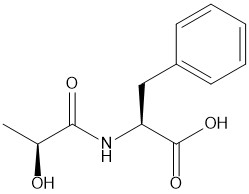
Lactoyl phenylalanine | Anorexigenic circulating metabolite
Available Options
| Size: | Price | Quantity | |
|---|---|---|---|
| 5 mg | $75.00 | ||
| 25 mg | $300.00 |
Exercise is associated with transient suppression of appetite which previously has been attributed to induction of appetite-regulatory hormone such as GLP-11 or the increase in circulating metabolites including L-lactate2. A targeted metabolomics approach with blood samples from two independent human exercise studies resulted in the identification of N-lactoyl-phenylalanine (Lac-Phe; 183241-73-8) as a highly upregulated circulating metabolite following exercise.3 Lac-Phe was shown, using pharmacological and genetic methods, to be an exercise-inducible metabolite that suppresses feeding and obesity. A single injection of Lac-Phe was demonstrated to reduce food intake by ~50% in diet-induced obese mice. However, Lac-Phe is completely inactive when administered orally.4
References/Citations:
- Hazell et al. (2016), Effects of exercise intensity on plasma concentrations of appetite-regulating hormones: Potential mechanisms; Appetite, 98 80
- McCarthy et al. (2020), The emerging role of lactate as a mediator of exercise-induced appetite suppression; J. Endocrinol. Metab., 319 E814
- Lund et al. (2022), Outrunning obesity with Lac-Phe?; Cell Metab., 34 P1085
- Li et al. (2022), An exercise-inducible metabolite that suppresses feeding and obesity; Nature, 606 785
C12H15NO4
>98% HPLC
NMR: (Conforms)
Safety Data Sheet:
Product Data Sheet:
Materials provided by Focus Biomolecules are for laboratory research use only and are not intended for human or veterinary applications. Please note that we do not sell to individuals and that all orders placed by non-research organizations will incur a $20 restocking/refund fee
Exercise is associated with transient suppression of appetite which previously has been attributed to induction of appetite-regulatory hormone such as GLP-11 or the increase in circulating metabolites including L-lactate2. A targeted metabolomics approach with blood samples from two independent human exercise studies resulted in the identification of N-lactoyl-phenylalanine (Lac-Phe; 183241-73-8) as a highly upregulated circulating metabolite following exercise.3 Lac-Phe was shown, using pharmacological and genetic methods, to be an exercise-inducible metabolite that suppresses feeding and obesity. A single injection of Lac-Phe was demonstrated to reduce food intake by ~50% in diet-induced obese mice. However, Lac-Phe is completely inactive when administered orally.4
References/Citations:
- Hazell et al. (2016), Effects of exercise intensity on plasma concentrations of appetite-regulating hormones: Potential mechanisms; Appetite, 98 80
- McCarthy et al. (2020), The emerging role of lactate as a mediator of exercise-induced appetite suppression; J. Endocrinol. Metab., 319 E814
- Lund et al. (2022), Outrunning obesity with Lac-Phe?; Cell Metab., 34 P1085
- Li et al. (2022), An exercise-inducible metabolite that suppresses feeding and obesity; Nature, 606 785
Calculate the molar concentration, mass or volume in a solution.
Concentration × Volume × Molecular Weight = Mass
STEM CELL
BOGO